
The Challenge
A highly deviated alternating water and gas injection well offshore Qatar had a known but unverified tubing leak. Pressure build-up in the casing to tubing annulus during gas injection indicated an intermittent leak that was not evident during water injection. The operator needed to locate the leak to install a straddle or patch and to be able to resume gas injection.
The zone of interest for the survey was from the surface to the production packer at 6,068ft. The well deviation built from around 1,000 ft reaching 80 degrees by 3,600 ft. At the packer depth the well was highly deviated (86 degrees) then continued to 22,415ft total depth with an open hole horizontal reservoir section.
Two previous attempts to verify the leak location using wireline multi-fingered caliper tools and noise logs had been unsuccessful, so Fli Dynamic De-Spool technology was employed as an alternative solution. Fli is a standalone intervention system that installs bare optical fibre along the length of the wellbore. The fibre delivers distributed data in real-time, giving a dynamic picture of the entire well compared to single point readings from wireline tools.
The Solution
The Fli kit would be airfreighted to the wellsite from Aberdeen and two engineers would attend the site to provide 24-hour cover. The probe would be pumped to depth, deploying bare fibre down the well and across the zone of interest.
A 2.75” BI-Fli probe with distributed acoustic sensing (DAS) and distributed temperature sensing (DTS) fibre would be used with 3.725” pump down cups to pass through 3.750” tubing nipples.
Since the tubing leak was only active during gas injection, the well would be displaced to gas with the probe and fibre in the well, to activate the leak.
The Results
The pumpdown was completed in under two hours using injection quality seawater treated with friction reducer using spike pump. The first image below shows the Fli acoustic data used to monitor the pumpdown. In comparison, the time to tractor-in for the previous wireline logs was 5-1/2 to 6-1/2 hours.
The gas for the bullheading was taken from a nearby donor well but the available volume meant it was not possible to fully displace the well, with the final gas level sitting above the production packer. This meant that a continuous leak could not be actuated, but the annulus pressure was manipulated until a small intermittent tubing leak was detected by Fli. The leak signature was repeatable but lasted less than five minutes in each instance.
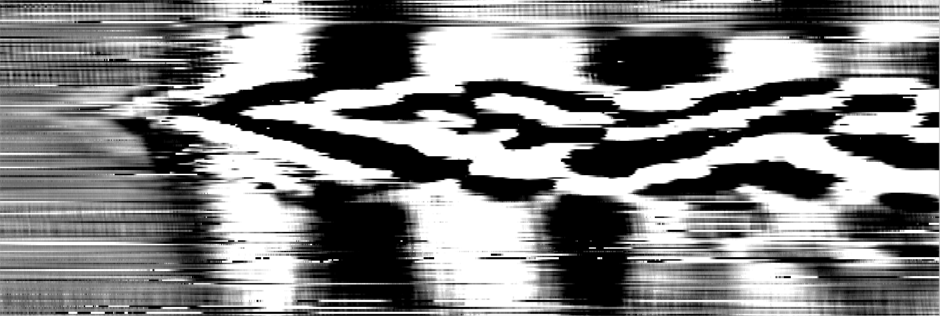
The acoustic response detected by Fli in the raw data was compelling and provided high confidence in the location of the leak which corresponded to a tubing connection. The black and white image below shows the raw DAS data indicating the actuation of the leak followed by a bubbling through of fluids.
The blue colour image below shows the ‘Quicklook’ DAS output from Fli provided to the client within 24 hours proving the leak had been located.
The operator now plans to set a straddle across the leaking tubing joint and intends to use Fli technology in future projects. The next well candidate is already lined up for a similar operation.
Value
- FLI can be used to accurately detect tubing leaks in onshore and offshore wells.
- Fli’s bare fibre is highly sensitive and can detect small and intermittent acoustic signatures which would be hard to detect using other methods
- Fli’s field-proven pumpdown deployment technique enables access to highly deviated and horizontal wells without any detrimental effect on the fibre.
- Fli’s pump-down technique can reduce survey time by around 50% compared to tractor deployed wireline surveys.
- Distributed fibre sensing provides a complete profile of the well, monitoring changes in temperature and acoustics in real-time.
- High quality data and rapid results enable fast decision making and efficient remediation operations.
- Fli’s leak detection is useful for production and pre-abandonment operations.
To find out more, please take a look at our CASE STUDY.

09.09.26
WellSense Announces Strategic Partnership with Precise Downhole Solutions to Expand Fibre Optic Well Surveillance in Canada.
03.06.26
New Partnership Drives Well Integrity Innovation in Malaysia.
22.05.26
SAP B Leak Detection - An operator led multi-technology trial
27.10.25
World’s first jet-propelled well conveyance technology completes successful US field trial.
25.09.25
WellSense Sells Fli Rapid Fibre-Optic Well Diagnostic Licence to an Oilfield Service Company
02.11.22
WellSense delivers industry-first fibre survey for the CCS sector
26.08.21
WellSense enters five-year exclusive agreement with Halliburton to supply FiberLine Intervention technology for North America’s unconventional wells
01.04.21
WellSense and Wellbore Integrity Solutions enter business cooperation agreement
05.02.21
WellSense announces new CEO
03.12.20
WellSense scoops ‘Most Impactful Technology’ title at the Global OWI Awards
16.10.20
WellSense honoured in World Oil Awards
19.03.20
WellSense wins 2020 Special Meritorious Award for Engineering Innovation from Hart Energy
13.11.19
WellSense gains ISO 9001 QMS certification


